18 March 2026

Fighting Feelings of Helplessness (in Today's World)

None of us knows what the next change is going to be,
what unexpected opportunity is just around the corner,
waiting to change all the tenor of our lives.    -Kathleen Norris

Personally, I have a very hard time feeling helpless, even at my somewhat advanced age these days.  I know where this feeling comes from, having learned a lot about personality traits of Adult Children of Alcoholics over the last couple of decades, but knowing where it comes from doesn't lessen the feeling.  Watching the world today and seeing all the hatred and anger and lawlessness--on the part of the US government, no less--makes me want to be out there doing something about it.  I want to be in Minneapolis protesting the constant violations of Constitutional law on the part of supposed "law enforcement" officers.  I want to be at the court when ICE detains someone who has come to an appointment in an effort to do the right thing and follow the correct processes for applying for refuge or citizenship.  I want to be in a congressional meeting to ask our supposed representatives why they're voting to pass laws that hurt millions of Americans and benefit only the already-wealthy.  I feel helpless sitting at home and being unable to do these things.

Of course, the fact that I'm living in Portugal makes that feeling even stronger when it comes to thinking about the United States.  (My wife and I are mainly here in Portugal because we wouldn't be able to retire in the States for many more years, while we are able to live comfortably here on the moderate income we get from Social Security.)

But one of the keys that I've learned about feelings of helplessness is that they are just that:  feelings.  The truth is that none of us are helpless, and none of us are unable to make contributions to the good and the just in the world if we really want to do so.  The truth is also that very, very few of us are able to make differences on a national or global scale--the world doesn't function that way.  Imagine if everyone had the same gifts and abilities, and everyone were able to be change-makers on a national or international scale--what kinds of chaos would we see then?

We can make differences, though, in our own worlds, among the people and organizations with whom and in which we function regularly.  We can add to the positive energy of the world by sharing encouragement and positivity.  If I'm watching the news and I see something happen that I can't influence in any way at all, I can turn around and do something positive that may not affect the situation I just saw on the TV or computer, but which may have very positive effects on very real human beings who could definitely use something positive in their lives.

I can't keep the shooter from killing people, but I can help a young person to learn a new skill, or provide food for a family that's struggling.  I can't keep the US from attacking Iran, but I can give donations to organizations that help millions of people every year--or I can donate my time and effort to those organizations, helping to provide that help.

Of course, helplessness can be more than feelings.  If someone points a gun at me and pulls the trigger, there's virtually nothing that I can do to stop the bullet.  When someone I know continues to act in ways that are self-destructive, I am helpless if they're somewhere that I'm not--if they're a thousand miles away from me, then there's literally nothing I can do to change a decision that they just made.  If the government raises taxes significantly in a legal way, there's not much I can do except pay the new tax rate if I want to continue to live where I live--and don't want to end up in jail.

The world is going to change, and it's going to change constantly.  And we do have to change with it if we're not going to feel even more helpless--we can see plenty of people who never learned how to use computers feeling completely helpless when it comes to things like online banking or using phones these days.  Most of the people who can't use the phones, for example, are more than capable of doing so, but they're just constantly deciding not to do so.  My mother spent years being completely unable to use the phones and complaining constantly about not being able to use them, until her situation made it absolutely necessary for her to learn--and she did so.  All of the time she had spent feeling helpless and stressed out, and all of the time she spent insisting that she simply couldn't learn how to use them turned out to be wasted time, and very frustrating time for her and for the other people in her life.

The world is changing quickly these days, isn't it?  And while there's absolutely no need for us to be proficient in every new technology or knowledgeable about every new development in the world, it is up to us to stay up with the changes that affect us directly if we're to live lives that are fulfilling and satisfying.  We can't ignore change and still expect to thrive.  The main questions for us are simple:  which changes are those that we need to adopt and adapt to, and which are ones that we can actually have some influence on?  If we let the world continue to change without us being a part of at least some of those changes, we're going to find ourselves in very helpless--and possibly hopeless--situations.


30 January 2026

Maintaining Principles (In Today's World)

It's important that people should know what you stand for.
It's equally important that they know what you won't stand for.
-Mary H. Waldrip


In the world of today, it's pretty easy to get the idea that living by principle is a concept of the past, something that some people used to do, but not so relevant or important today.  After all, we see all over the place the people who have no principles at all to live by, and they're being rewarded over and over again, especially financially.  Lots of people are making lots of money without having to display even the slightest indication of principled living--or who demonstrate principles such as greed, materialism, and even hatred and anger as ways of life, while people who do stick to principles such as honesty and fairness and equality are mocked and even punished for decisions they make to stick to their principles.

It's a sad situation, and one that most certainly is going to leave deep footprints in the future of this world, especially in the United States, where more and more people are less and less interested in holding people accountable for wrongdoing, abuse, violence, bigotry, and many other things that used to be unacceptable to anyone for whom principles were an important part of their lives.

Somebody just attacked a public figure who happens to be Muslim, and a police lieutenant went online and posted a rather despicable "joke" about the incident.  He was immediately placed on leave, and retired the following morning.  He obviously didn't follow principles that have consistently been demanded of persons in law enforcement, who have to deal with people of all backgrounds on a regular basis, and he did pay a rather heavy price for it.  In that sense, we can see that principles are still present in many forms and situations, and that's a good thing.

But go to the Facebook page of the television news program that reported on his retirement and read the comments.  Many of them are horribly negative, but the truth is that the vast majority of the people who commented said basically, "he should be able to say whatever he wants about anything or anybody he wants."  In the comments, you can see a complete lack of principled thinking, of the idea that people should be living up to certain standards, especially if they're public servants.  And most of the people think it's okay for him to do so because they dislike--or even hate--the person who had been attacked.  Their idea of "principles" seems to apply only to people they like and people they agree with.  But if you're different than I am, or if I don't like you, then my principles don't matter.

And this is a direction we've been taking in this country for quite a while now.  We've become a society in which people like to judge each other harshly and relentlessly, and such judgment allows us to make "exceptions" to our principles--we don't have to stick to them if the other person "deserves" something.  That person next door supports green people, so my principle of treating other people with dignity and respect doesn't apply to that person.  The man in the house across the street supports teaching something to my kids in school that I disagree with, so I'm not required to be honest to him because he doesn't deserve my honesty.

It's really quite sad and sick.  And the damage that this new ability to modify our own principles to fit different situations does is very real--we can hurt people, we can destroy communities, we can sabotage our own efforts to live well because we're not allowing ourselves to live honestly and live authentically.

I need to stick to my principles if I'm going to be able to live my life fully and happily.  If I believe in the principle that all people deserve my respect, then I really must respect the rights that other people have to their own beliefs.  No, I don't have to agree with them, and no, I don't have to support them, but I do need to stick to my principles.

And if I do want to follow those principles, I can't call them names, mock them, or treat them badly.  I can despise them and all that they stand for, especially when they're racist or misogynistic or cruel, but a principle of decency and respect is just that--a principle that I don't want to violate lest I make myself into a person who is much less than I want to be.  No, I don't need to socialize with them, and no, I don't need to tell them that their views are justified in any way, and no, I don't even need to feel that their beliefs are necessarily valid.  But I do need to respect their right to have those beliefs and to follow them.

But what if the acting out of those beliefs causes harm to others?  Then, of course, our principles of treating others with dignity and respect overrule any beliefs that cause people to harm others.  My principles cannot allow for the harm of anyone simply because I don't agree with them, but they also cannot allow for me to be wishy-washy and step back and do nothing when innocent people are being harmed.  If I were living in Minneapolis right now, for example, my principles would compel me to be out on the street, protesting, or working for justice in some other way.  Sitting quietly and saying nothing would simply contradict my principles that reflect my belief in social justice.

In short, we can look at it this way:

If one of my most important principles is for others to be treated fairly, then I must treat people fairly.
If one of my most important principles is that all people are created equal, then I must treat all people equally.
If I expect honesty from other people, then I must be honest myself.
If I expect my children not to swear, then I need to be careful of my own language.
If I expect other people to be loyal to me, then I must practice loyalty.

In short, if there's a disconnect between what we claim to be our principles that we hope will guide us in living our lives in certain ways and the ways that we actually live our lives, then we're most certainly NOT living life fully, and that's probably the case because of our own tendency to violate the principles that we claim to be important to us.

What are your most important principles?  Do you live by them all the time?  When you can answer "yes" to the second question, you'll be well on your way to living a full and fulfilling life.


13 January 2026

Acceptance (In Today's World)

Acceptance is not submission; it is acknowledgement of the facts
of a situation, then deciding what you're going to do about it.
-Kathleen Casey Theisen


I'll be very honest--it's become very difficult to accept the things that are happening in the United States these days.  The masked "law-enforcement" officers, the deportations of people who don't deserve to be deported, the pardoning of scores of guilty people who were given fair trials--the list goes on and on, and it's getting worse and worse.  And the unjustified murder of an unarmed woman in Minnesota seems to be the next step in the escalation of actions and policies designed to sow chaos and disorder, to pit people against each other on political and ideological bases, and to keep people from trusting anyone, anywhere.

But accept these things we must, because until we acknowledge the truth that things are not going to go back to how they used to be, we'll never be able to move forward, away from the awful things that are going on.

No matter how much we don't want to admit it, the current situations in this world make it impossible to go back to any sort of "good old days."  We may want to say things like "There's no way that I'll accept a killing in Minnesota," but when one says such a thing, then one is talking about denial, not ethics or morals.  If anything is going to change in this world, then the current facts must be accepted as a first step towards change.  Things are as they are, and pretending they aren't happening is to sabotage any chance for healthy change.

Accepting the fact that a woman was killed in her car while doing nothing wrong does not, by any stretch of the imagination, mean that you somehow condone the action.  It does not mean that you support the people who did it.  It doesn't mean that you don't care about it.  It simply means that you're willing to say "Yes, this did happen."  "Yes, I live in a country in which a man wearing a uniform is allowed to kill anyone he wants without facing any repercussions so far, and who is actually defended by many people in positions of power."

And acknowledging that fact along with all the other horrible things going on means that we're aware of them, and that we know that change has to come from the place we're at, not from the place we wish we were.  Alcoholics can't really start to overcome their alcoholism until they accept the fact that they're alcoholics.  Until I accept the fact that the kitchen faucet is broken, I can't fix it.  And when I do work on it, I undertake the job knowing that it's broken, not hoping that it's going to miraculously fix itself and be as good as it was last year at this time.

Acceptance is often very difficult.  Right now, it's very hard for me to accept that the country I've lived in for many decades is no longer the same country as it was when I was a kid--opportunities for everyone have dried up as the wealth disparities grow more and more pronounced, and the spending power of the money we earn shrinks regularly.  The amount of debt that young people have to rack up in order to get a college education cripples them, and simply sabotages their futures.  The young people I know today simply don't have the opportunities ahead of them that they would have had at the same age forty years ago.  These are simple facts, and I can't ignore them or deny their importance.

But I still hope for change.  I hope for improvement.  I know that it can't come from me, for I have no real influence on any policies or policy makers, but I accept the fact that I can't affect things directly, and I still try to affect things indirectly as much as I can.  I've taught for almost forty years because I've wanted to do all I can to help young people to know things that would help them in life, and I can keep on teaching, hoping to help people to see directions they can go and methods they can use to bring about change themselves.  I accept my limitations because I know that I can still accomplish something, but I don't waste my time or energy doing things that won't have any effect at all.

Acceptance is not submission.  Acceptance is strength, acceptance is clear-headedness, and acceptance is awareness.  Acceptance is one of the first things that has to happen before any change can be implemented, and it's one of the most important elements of our lives.


30 December 2025

Preparing for a New Year (In Today's World)

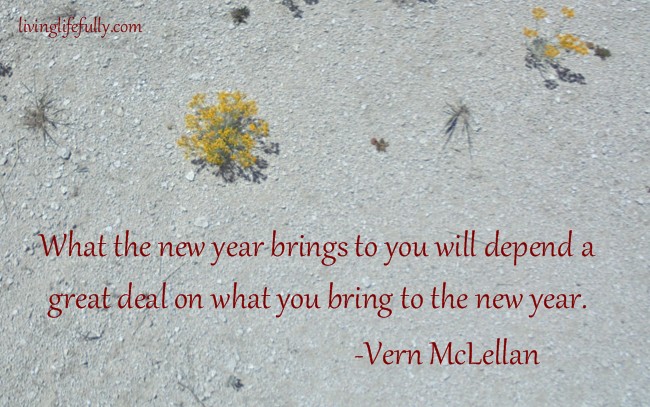
It depends on us. . . Another year lies before us like an unwritten page,
an unspent coin, an unwalked road.  How the pages will read,
what treasures will be gained in exchange for time,
or what we find along the way, will largely depend on us.   -Esther Baldwin York


It's almost time to welcome a new year into our lives.  Although the measurement of years is a completely artificial way of dealing with the concept of time, most of us subscribe to it to one extent or another, so starting a new year in our lives does matter to most of us.  We see the "new start" as a fresh opportunity for change, for beginning new projects, for repairing relationships, for learning new skills, for getting in shape. . . the list is very, very long, obviously.

From what I've been hearing and reading over the last year, though, it seems like many people are not seeing the "opportunity" part of the new year, especially people who have lost jobs or who are making much less money than they made last year, or are spending so much more on basic living expenses that they don't see any way possible for them to take on anything new.  And all of the people who are going to have to spend much more money every month for health insurance are facing a year when they'll probably be struggling to keep their heads above water, much less thrive or be able to fill their new year with new goals or projects.

A mother who's now going to have to pay much more for insurance this coming year won't have the income necessary to take the college courses she needs in order to advance in her job or to change jobs.  A family that has seen its work diminish severely due to economic factors such as tariffs, which are making the less wealthy people suffer more than anyone else, won't be able to afford to take that vacation they've been planning on, and they won't be able to afford the extra classes that their son or daughter needs.  Families that are paying much more for utilities, rent, or mortgages will be stuck just trying to get by.

Of course, the most important element of getting ready for the new year is accepting the reality it currently presents, the possibilities and limitations, for they're real for most of us.  Accepting a limitation does NOT mean that we think we can't do anything to get over it, of course, but unless we accept it for what it is currently, we simply won't be able to try to overcome it.  Acceptance means that we know what our current situation is, and that our plans fit realistically into the reality we're living.  If my disposable income is $500 a month, then I probably shouldn't be planning a summer in France.

Personally, my wife and I see many such limitations in our future, as we've recently retired and we'll be living on that famous "fixed income" that definitely limits our possibilities.  The first thing we did in order to retire was to move to a country that's much less expensive than the States, because we want our money to stretch as far as possible while we still try to maintain a basic quality of life.  We're not people who have inherited lots of money or who have a home that's completely paid off, so the income we get will be it.  The good side is that by moving, we were actually able to retire--had we stayed in the States, we would have had to keep working at least another ten years, probably.  So our planning for the next year is rather simple--we'll take many day trips to explore our new surroundings, but we won't be planning any extensive vacations for the year.  For us, this will be a year of settling in and getting used to life in a new country and to new ways of life.

What will your new year look like?  Will this be a year of being careful with money?  If so, how can you still maintain a decent quality of life while spending less?  Does this mean fewer meals out, fewer trips, and fewer luxuries?  Perhaps this can be a year of focusing on improving family relationships or friendships.  Maybe it's a year to spend at home, strengthening your home life.  Many people find time that they spend at home to be beneficial because they can read more and do more things with their families.  Perhaps a game night each week can strengthen ties better than a meal in a restaurant can.

Or will your financial situation not change significantly, so you can continue to do the things that you like to do, that make life more interesting and enjoyable?  You can still look for ways to strengthen relationships that you already have, to improve the home you live in, to contribute to the neighborhood you live in.  Maybe it's time to buy a few books on something that fascinates you, and learn more about it.

Or will you be doing even better financially, so you can do some things that you've dreamed of doing for a long time?  Then congratulations, and have fun!  Just try to keep in mind that those people who use at least some of their money to help others tend to be happier and feel a stronger sense of purpose and fulfillment.  Giving back to the world is one of those things that everyone sees in different ways, but that tend to make people happier and more emotionally well-balanced.

Your new year is coming up, or has already started, depending on when you're reading this.  Right now, you're just thinking of what's coming and how you're going to deal with it all.  I would say that Esther is right--what this year becomes definitely will be affected by outside circumstances, but will mostly depend on us and how we approach the year.  Once we accept where we are and what we have and what we don't have, we can get to work trying to improve things, if necessary, or to maintain things that should be maintained.  My main hope is that you're able to make your coming year a wonderful year indeed, in both your own life and in the lives of the people with whom you associate in one way or another.  What we make of 2026 is up to us, isn't it?


26 December 2025

Christmas Wishes (In Today's World)

What is Christmas? It is tenderness for the past,
courage for the present, hope for the future.
It is a fervent wish that every cup may overflow
with blessings rich and eternal, and that every
path may lead to peace.

Agnes M. Pharo


Somehow, Christmas has always been a time when people like to think about other people, to think about what it means to be a kind, compassionate, caring human being who does good for other people without worrying about their nationalities, their skin color, their sexual orientation, their native language, or any of those other things that so many people lean on to justify their biases and prejudices.  Unfortunately, though, so many people in our world have allowed themselves to fall into the trap of allowing their biases and prejudices to dominate their world-view, and they've allowed those things to also dominate their decision-making processes, so we live in a world that's divided, among people who fear each other more than they love each other, who hate each other for no real reason, and who don't trust each other even on the most basic of levels.

But here we are--no matter how we feel about the world today or the ways that people are treating each other, we're in the middle of it all, right here, right now.  and realizing this truth calls us more than ever to be true to who we are, to our principles, to whatever ethical codes that we hold dear.  Do we feel that human beings should show kindness and compassion to each other?  Then we need to be showing kindness and compassion ourselves--and perhaps trying to show more of each in a world in which it seems that both qualities are in short supply.

Do we feel that there needs to be more love and hope in our world?  Then we need to start with ourselves, and make sure that we keep love in mind when we deal with others--we can't preach love while our own hearts and spirits aren't in a loving state.  And it's not easy to maintain a loving state when we see so many awful things being done to others who are helpless to defend themselves.

Christmas, of course, is a holiday celebrating the birth of Jesus, even though his birthday was likely not in December.  And if the holiday is about honoring Jesus--religious beliefs or preferences aside--then it seems to me that we should be thinking about things that Jesus taught.  After all, we're all encouraged to think about civil rights on Martin Luther King's birthday, and freedom on Lincoln's birthday, etc.  But because of the historic truth of the "Christian" churches committing all sorts of crimes against humanity, the teachings of the man take a back seat to the myth of the man's words that have been warped by religious leaders who have been doing little more than trying to justify their own awful deeds by presenting Jesus' words in ways that will make them seem to be following those very words, when in fact they're violating the man's teachings.

So my main Christmas wish would be that the people who believe that Jesus was the Messiah could start to actually understand what Jesus taught, and follow his true teachings, rather than simply listening to other people who are presenting their interpretations of the man's words.  Perhaps Jesus could come back for a few months and start an online course that he could make mandatory for anyone who calls themselves Christian, a course that will spell out explicitly what it means to follow the words of a man who taught kindness and compassion and love for one's neighbor.  If this would happen, MANY politicians would lose their next chance to be reelected, and MANY pastors and priests would be out of a job, taking them out of positions in which they influence people.

And that may be my only wish because I think it would be a great start.  If this were to happen, so much of the hypocrisy and discrimination in the world would cease, and we might not need anything more than this to create a kinder and gentler world.  I think I'll hold off on any other wishes until I see how this one turns out. . . .


13 December 2025

'Tis the Season (In Today's World)

For me, the spirit of Christmas is about
letting the loving but messy little rituals
become just as important as the solemn
and graceful ones.  It's about making
room for everyone.   -Ann Michael


It's going to be difficult this year, I think, to celebrate Christmas without having the thought in the back of my mind that celebrations are somehow inappropriate or out of place.  After all, the world is going through so many challenges now that make things seem almost hopeless.  The war that Russia started in the Ukraine drags on, while people are still dying.  The conflicts between Israelis and Palestinians continue to claim lives, while militants in African nations have killed over 20,000 people this year.  The US is continuing to kill people on boats near Venezuela, and is indicating that war may be imminent.  Millions of families have been devastated by poverty and illegal ICE detentions and layoffs.  The list could go on for the rest of this page, it seems.

But so this is Christmas.  'Tis the season of peace and love and joy, or at least it's supposed to be for Christians.  Unfortunately, many Christians in the United States have become radicalized, and they've warped the main messages that Jesus taught:  Love one another, help one another, be kind to one another.  This new dynamic most definitely does diminish the message of Christmas, unless we're able to separate those people who have adopted radical and inappropriate interpretations of Christian teaching and the Bible from the holiday itself, which can still stand as a beacon of hope and love and even joy.

My Christmas is going to be separate from the radical, hate-filled messages of the people who aren't able to separate their politics from their religion.  If I'm to celebrate Christmas properly, then I need to focus on love and compassion, on others and their needs.  And I need to make sure that I take advantage of my personal situations in order to make the most of them--I'm not going to be able to celebrate love if all I do is focus on the negative things going on in the world.  I don't want to forget them, but I also can't let them bring me down.  If I were in a terrible situation myself, I would want people who weren't in the same situation as I to go on with their lives, and to live fully and take advantage of all they have available to them.

Which is not to say that I would fully understand someone who decides to "cancel" Christmas in solidarity with those who aren't able to celebrate because of life situations that have been pushed upon them by others.  Would the lack of celebration for just one year be a sign of giving up completely, of letting the world get us down?  Absolutely not.  It could be a very strong message to others that our commitment to other human beings is strong and that the well-being of others is just as important to me as my own well-being.  I know that there are people who are deciding to do just this, and I understand completely where they're coming from--they're not letting the world situations get them down; rather, they're standing strong in the face of those situations and doing what they feel is right, in their own way.

We're going to celebrate, because much of the rest of the world is going to celebrate.  We want to stand together with the people in the world who want to celebrate the ideas of love and kindness and giving and compassion.  I'll enjoy the lights and the music, and I'll give gifts to as many people as I can to show that I'm thinking about them and that they mean a lot to me.

Life is difficult right now for many, many people.  Life is difficult for me at the moment, but I still have things much, much better than millions of other people do.  And even in difficult times, I wouldn't want people who are in better situations to avoid celebrations that are legitimately worth celebrating.

So here's to celebrating a Christmas during which we focus on loving one another, and healing one another.  A Christmas during which we share kindness and caring for one another, and during which we celebrate the wonderful potential we all have to help others in this life, and to give all that we can to the other people who share this planet with us.  I wish you a very merry Christmas, and I hope that we all can work together to bring more love into the world in the hope that the love will drive out the hatred and fear and anger.


08 December 2025

Finding and Maintaining Peace (in Today's World)

Quiet minds cannot be perplexed or frightened, but go on in fortune
or misfortune at their own private pace, like a clock
during a thunderstorm.

Robert Louis Stevenson


This has been one of my biggest difficulties during the last few years--finding peace of mind and peace of heart in a world that seems hellbent on creating chaos, stripping people of their peace in order to try to get them to act in certain ways, to buy certain things, to refuse to do certain things.  How do we go about making sure that our minds are "quiet"?  What do we need to do to have peace of mind in a world in which government agencies are acting just like Nazis, in which masked "officers of the law" are stripping people of their constitutional rights, and institutions such as the Supreme Court--which is charged specifically with protecting the Constitution--are not only turning a blind eye to abuses, but actually encouraging and allowing them?  In a world in which one country just spent two years killing civilians in the "country" next to them, and faced no international repercussions?  In a world in which one country can invade another, killing civilians for no justifiable reason, just to try to take over territory, and face no effective international response at all?

I'm not talking about losing peace because of guilt, though some might say that we should feel guilty about others suffering so much.  Rather, I'm talking about simple compassion, feeling the pain that others are feeling rather than simply talking about it.  The question I ask myself constantly is basically, "Why am I so privileged to have all I need and to face no real threats to my security or well-being each day, when so many others are literally facing death each day through no fault of their own?"  I do appreciate the fact that my life and well-being are rather secure, but I feel very strongly that that should be the truth for everyone on this planet, not just a select few.  And the reality that it isn't the truth makes it hard for me to be at complete peace with myself and my place in the world.

I'm not saying that I blame myself for anything, or that I spend sleepless nights thinking about children dying of starvation in a country far away from me (though perhaps that would be justified).  Rather, I want to continue to be a kind and compassionate person, having a positive effect on the world (no matter how small).  And it's very difficult to think that the positive effect I may have grows less and less significant as time goes on.  It feels like the two sides of the scale are growing more and more unequal, and my contributions do less and less to balance the two sides--this is unequivocal, no matter how sincere or even strong my contribution is.

I can have peace in my own corner of the world, of course, which is my highest priority.  I can feel peace about the ways that I treat others and about what I try to give the world in my own personal ways.  When all is said and done, though, I do know that there's much more to the world than what I see and experience every day, and knowing that there's so much pain and cruelty and dysfunction out there gives me cause to stop and consider why so many people are going through agony when I'm living a life that's pretty much free from it.  I don't have to worry about anyone coming to my door and arresting me because of the color of my skin or my religion or my country of origin--but I do know that many of my fellow human beings on the planet where we all live do have to worry about those things and much, much more--including being killed by bombs or missiles or gunfire or even beatings.

And if I'm to live my life fully, I know that my life must be a life of compassion and empathy.  But should my compassion and empathy cause me to lose my peace of mind?  Must I walk around feeling down and depressed all the time because other people are suffering?  Of course not.  If someone dear to me dies, I wouldn't spend the rest of my days being miserable because of the loss.

But I do feel that I must take other people's suffering seriously, and not forget the people who are dealing with terrible problems every single day, while things are going well for me.  But I feel that I'm still responsible to be grateful for all that I have, to feel wonder and awe for the world around me, to feel love for all that surrounds me--and to keep in mind the fact that not everyone has things as good as I have them.  Keeping this in mind will keep me humble, I believe, knowing that I'm very fortunate to have the blessings I enjoy.  It will also keep me grateful for and mindful of all that is in my life.

Knowing that others are starving won't keep me from buying food for myself or even eating in a restaurant, but it may help me to be more responsible when I choose what I buy.  Knowing that others are huddled in houses hoping that bombs won't kill them won't keep me from going for a walk in the park or a hike in the woods, but it can help me to appreciate my ability to do so without the threat of dying.  Knowing that others don't have access to medical care won't keep me from visiting a doctor when I need to, but it just might help me to feel gratitude for the fact that I can do so.

If I can keep my sense of balance, my equanimity, then my peace will not leave me, and my life can be fuller because of that peace.  I can sleep better at night, and I can enjoy better sleep and lower blood pressure and stronger health due to the peace that I feel.  I may live in a world that invites me to feel stressed, to feel tension every moment due to the unfairness and danger that so many humans face, but when the simple fact is that I can do nothing--or very little--to help those others, my responsibility becomes to simply and carefully live my life as fully as I can, helping others as much as I can and as well as I can so that I'm contributing to the peace and love and hope of the world rather than being destroyed by the anger and hatred and violence in it.


25 November 2025

Thanksgiving (In Today's World)

Be thankful for all those who have helped you to grow--
 your teachers, parents, employers, friends, spiritual guides,
and others, acknowledging them by name.  Be thankful for
the good books which you have read, inspiring sermons and
talks you have heard, as well as your own notebooks and journals.


Finally, be thankful for the challenge of your own personal future.
Be thankful for your dreams, your ideals, your hopes.
There are unlimited possibilities ahead.   --
Wilferd A. Peterson


Thanksgiving day comes tomorrow in the United States, and I have to say that it's difficult to think about sitting around a table being grateful for all that we have when there are so many people in the country sitting in cells, facing deportation, even if they've been contributing members of our society for years or even decades, just because they got a traffic ticket ten years ago.  They're facing deportation to countries they've never been in, where they have no family or friends to support them.

It's hard to focus on my own Thanksgiving when I know that so many people are going to lose health insurance because they can't afford it any more, and that so many people can't even afford to do their food shopping these days.  Hundreds of thousands of people have lost their jobs this calendar year, so they're not going to be able to furnish their normal Thanksgiving day dinner--much less provide their families with many of the things that make for a "normal" Christmas.  And that's just in the States--we still have the horrors of Gaza and the Ukraine to consider, among many other ways in which people are suffering in this world of ours.

Of course, Thanksgiving day can be wonderful for me if I forget these people and the trials they're going through, but it's impossible to do that and still have a feeling of connection to all humanity.  I'm a part of humanity, not a little island all on my own.  "No man [person] is an island entire of itself," wrote John Donne; "every man [person] is a piece of the continent, a part of the main."  And if I am a part of humanity, then other people's suffering will affect me--it's simply one of the effects of empathy and compassion.

That doesn't mean that I have to be miserable, though, thinking about how others are suffering.  But it does mean that when I think of myself as a part of the whole, and I know that many who are also part of that same whole are suffering greatly, it's important that I keep them in mind, that I keep them in my heart, that I keep them in my prayers, however I choose to pray.  I am thankful--extremely thankful--that I have enough money and other resources to wake up each morning in safety, and that I don't face any world-changing threats to the life I'm living at the moment.  I can give thanks for what I have, but I need to recognize that it wouldn't take all that much to put me in a desperate situation, for then I can feel more empathy and compassion for those who are suffering, and I can look for ways that I can take little actions that might help them make their ways through difficult times.

Thanksgiving is a wonderful holiday, and I most definitely will be thankful tomorrow (as I try to be every day).  But in that thankfulness will be more than just a bit of sadness and frustration as I think of the millions of my fellow human beings who are struggling and suffering.  I don't want to let that thought diminish my own gratitude, of course, for the things and the people I have in my life, but I don't want to be so strongly focused on the blessings that I have that I forget about the people whose blessings are much less abundant than mine.  I hope that everyone is in my prayers and thoughts tomorrow, for love is, of course, what makes the world go 'round, and my conscious awareness of the struggles of others is definitely a show of love.  The world is rarely moved in great ways to make great changes; rather, it's nudged in healthier and more loving directions by the many prayers and small actions that we all can say and take each day.


20 November 2025

Sharing Compassion (in Today's World)

Our task must be to free ourselves by widening
our circle of compassion to embrace all living
creatures and the whole of nature and its beauty.
-Albert Einstein


In this age of division, is it possible that compassion is our key to somehow finding unity once more?  Some of our leaders want us to think that in order to end division, we must "defeat" those who disagree with us.  Others feel that the key to unity is finding common ground even among our division and disagreement, to acknowledge the rights that others have to think and feel as they do, to accept them and their thoughts, and to work together even when we disagree on some points.

Compassion is "feeling with" someone, trying to understand their actions and thoughts and motivations.  It's rather easy to feel compassion for someone who obviously deserves it--the person who's been injured, the friend who has lost their home, the someone who has been abused.  But when we can't easily see the actual sadness, when we don't know the sources of a person's problems, it can be much more difficult.  That person who is against what I'm for more than likely has had some very poor teachers in their life, people who taught them to hate and to resent rather than to love and respect.  And we don't know what led them to actually believe this teacher, to follow their advice.  But it's very possible that even though this person is doing bad things, they're in great pain themselves, and it may be that pain that's leading them to hate, to judge, to harm others.

Since we can never really know what's going on in another's life, it seems that the most effective approach we can take is to make compassion our default response.  That doesn't mean that we should accept and approve of all that other people do, but if we can act around them with compassion, then we can understand that their harmful actions may be the result of great pain in their lives, rather than character flaws or simply being "wrong" or "stupid."

Many people have received poor educations, and it would be unfair of us to judge their words or actions by the same standards that we would expect from someone who's been educated deeply and broadly.  Some people are so afraid of everything that they base their prejudices and biases on their fear, and not on anything concrete or even logical.  And most of them never realize just how much power they give to their own fears.

In a world in which it seems like compassion is dying, just who's going to keep it alive?  Well, I can, and you can.  We're not obligated to do so, of course, but compassion sure seems important enough to me that I want to do all that I can to make sure that it doesn't disappear completely from humanity.  I must foster it, maintain it, share it freely--even with those who don't "seem" to deserve it, and let it be a guiding force in my own life if I'm ever going to have the chance to call myself a "compassionate person."  And on the day that I die, that's a term that I hope more than one person uses to describe who I was when I was here.


16 November 2025

Adding to the Positive (in Today's World)

The world needs huge positive energy to fight against
the negative forces. Go to the center of your inner begin
and generate that positive energy for the welfare
of humanity.    -Amit Ray


"The world needs."  Yes, it does.  And where is this positive energy going to come from, if it doesn't come from us?  Who is going to contribute to the world in positive ways if we don't?  Sometimes, though, it seems like an overwhelming task, something immense to ask of us when we're doing all we can just to get by.  How can my tiny bit of positive energy affect the world as a whole?  How can my optimistic words or actions help those people who are suffering greatly right now?

And because it's very easy to feel this way, to think that our thoughts or actions can't be helpful on a grand scale, we give up, and we simply plod through life, beaten down by the sheer overwhelmingness of the awful things that are happening to other people.

But the important thing to remember is that our positive actions don't have to affect the entire world.  They don't have to bring hope to millions of people.  We live in a large world, yes, but we also live in our own little worlds, surrounded by the people who share that world with us.  My world doesn't even consist of the town or city I live in--it consists of me and the people with whom I have contact, one way or another.  My obligation to the world is simply to do the best I can to help to expand positive energy in my world, and then trust that it will ripple out from there.

If I encourage a student today, then she may go home and do something positive for her little brother (whom I shall never meet), or her parents, or another student at school, simply because she feels more positive now.  And then, it's very possible that her positive action for her sister's sake will make her brother feel very good, and that he'll do something positive for someone else.

If I compliment someone who works in a store or a restaurant or in a public service position, then there's always the chance that the person will then "pass it on," complimenting or helping someone else in some way.

We're talking about ripples, about waves that expand from a central point and grow larger as they go, turning still water into moving water, just for a few moments.  We don't have to change the world--we just need to start a ripple, turn on one light switch, light one candle.  You can choose your own metaphor.

The world needs positive energy, especially during these rather dark days when people are reacting more to their fear than to their love, more to their anger than to their compassion.  And it's got to start somewhere, or it will never start at all.

Let it begin with us--you and me.  We can't change the world in one fell swoop, but we can contribute to the positive energy that this world so badly needs.


03 November 2025

Feeling Overwhelmed and Helpless (in Today's World)

The more I think about the human suffering in our world and my
desire to offer a healing response, the more I realize how crucial
it is not to allow myself to become paralyzed by feelings of
helplessness and guilt.  More important than ever is to be very
faithful to my vocation to do well the few things I am called
to do and hold on to the joy and peace they bring me.  I must
resist the temptation to let the forces of darkness pull me into
despair and make me one more of their many victims.    -Henri Nouwen


"The more I think about the human suffering."  This is such a difficult concept to come to terms with, especially for those of us who are fortunate enough to not be subjected to things that make us suffer.  It seems that these days, many more people are suffering than ever before.  That may not be true, for when we figure in our immediate access to news that we probably never heard before, plus the sheer number of people on the planet, more suffering and more awareness of suffering seem inevitable.

However, it is also true that things are happening in today's world that we simply haven't witnessed before.  Never in my wildest imagination would I have imagined what has happened in Gaza for the last two years actually happening, with the world watching and doing little to nothing to help out.  Not only have we seen a military killing almost indiscriminately, but we've also seen a situation in which food and medical aid for people who were sick and starving were completely forbidden, and people who tried to get food to starving children have been actually killed for their actions.

And in the United States, families are being torn apart because we have masked, uniformed people roaming the streets and beating and arresting virtually anyone they want, with little to no control.  Foreign-born people who are in the country legally are being arrested and deported, often for no legitimate reason.  Many people in the country wake up every day afraid of what might happen to them if the officers decide to arrest them today, for they often have little legal recourse available to them, even if what the ICE officers is doing is illegal.

As much as I would like to, I cannot solve these problems.  I cannot help these people personally.  And I have to say that it hurts to say that, because I would like to be able to do so.  So what can I do to help me to get along with my life without being overcome by feelings of helplessness and despair?  I think that Henri has hit the nail right where it needs to be hit:  I can continue to do what I'm doing and do it well, helping myself to avoid despair and to bring some peace and hope to the people who are a part of my world.  I'm not a person who has universal effect on anything, but I can keep on keeping on and put more positive energy out into the world.  The hard part is being satisfied with that, of course, but that's simply a question of my own perspective, and my acceptance of some very real limitations.  I can't do everything, and no one expects me to.  I need to do the best I can with what I have, and be satisfied with that.  I may be helpless to stop massacres in the Sudan, but I'm not helpless when it comes to showing kindness to others and helping them in ways that I'm capable of.


(page coming very soon)


27 October 2025

Battling Ignorance (in Today's World)

There is no evil in the universe which is not the result
of ignorance, and which would not, if we were ready
and willing to learn its lesson, lead us to a higher wisdom,
and then vanish away.   -James Allen


One of the most incredible defining features of our current world is the extreme amount of ignorance to be found among people of all social groups, of all economic groups, of all nationalities.  Unfortunately, ignorance has become a tool for many of the world's politicians, just as poverty has always been a tool.  The politicians understand that if the population is literate, then voters will be able to recognize the lies that politicians regularly use to get elected, and then they more than likely wouldn't vote for the candidate come election time.  The current situation in the United States is due to this dynamic--the quality of education in the States has been declining steadily over the past four decades or so, and as a result, we have many millions of people who are willing to accept lies as truth, and to repeat those lies to others, presenting them as "facts."  They do no research on their own to find out if something is true or not, because it's easier just to believe the people who are lying to them.  Something like Fox News isn't an accident--it's a carefully crafted tool designed to make people think they know facts that support one political party, while simultaneously getting them to hate and fear the "opposition," or those who don't agree with them politically.

So what do we do about this?  In these days when ignorance not only has been institutionalized but also is celebrated, what can we do?  Of course, as with all else we have to start with ourselves if we want to be making our lives all they can be.  We need to educate ourselves, first of all, on the issues that truly matter to us.  We obviously don't need to be experts on virtually everything, but we do need to be able to back ourselves up if we're going to be discussing important issues.  And we need to make sure that our sources of information aren't solely those that we've chosen because we like what they say.  We need to listen even to people with whom we disagree--at least, listen to them until their arguments are proven to be fallacious.  Part of our research can be simply to read a certain amount of news each day, paying close attention to the sources of any information we may use to back up our own arguments.  It's also important that we actually listen to opposing arguments, partly out of respect, and partially to understand exactly what the other person is trying to say.

I will always be ignorant of certain subjects.  I'm not an economist, and I never shall be--but there are plenty of people who are experts in that field, and if I find some that are trustworthy, then I can have a valid opinion on the directions a national economy should go, based on what I've learned from their expertise.  I don't have to have a degree in economics to have a solid understanding of what's going on in the world economically.

We don't want to be ignorant--but we have to make an effort to learn if we're going to be able to say that we're truly not ignorant.  And each of us always will be ignorant of certain things--after all, ignorance is simply not knowing something, isn't it?  The problem that we're facing is that ignorant people are claiming to know things that they truly don't know, and to introduce laws that support their biases and prejudices, rather than make life better for everyone.  And that kind of ignorance is harming many, over and over again.  This is a struggle that has to start by looking at oneself and making sure that we're doing all we can to make sure we're not part of the problem.


22 October 2025

We Really Do Need Hope (in Today's World)

If we were logical, the future would be bleak indeed.  But we
are more than logical.  We are human beings, and we
have faith, and we have hope, and we can work.   -Jacques Cousteau


In some ways, I've come close to losing my hope these days--and why wouldn't I?  In my country, the system of checks and balances that our government is supposedly based on has crumbled, and is completely failing the country now.  We have politicians who, because of superiority of numbers, are able to do virtually anything they please, without facing any consequences, for they've seen the flaws in the system and rather than fix those flaws, they exploit them, to the harm of all.  I'm watching people violate Constitutional law constantly while facing absolutely NO repercussions for doing so.  I'm seeing families torn apart while people pat each other on the back for having done so--even though no one in those families has done anything to deserve that fate.  It's depressing, and it's disheartening.  And to be completely honest, I believe it's all quite evil.

But I do hope.  I have the hope that things will turn eventually.  I don't know what it will take--a general or two to finally stand up and fulfill their vows to uphold the Constitution?  A group of people elected in the mid-terms who can turn the tide and help to keep the rule of law from being violated constantly?  I know in my heart, unfortunately, that we face the prospect of the entire country being sucked into an abyss of corruption and violation of law, but sometimes things have to be broken down completely in order to be rebuilt better.

My hope is that better times are ahead, especially for our young people, who don't deserve the obstacles that we've put in front of them by simply accepting all that happens in our government and in the business world.  I have hope that we can allow our humanity to shine in the ways that we spread kindness and love and compassion.  I have hope that we can work together, rather than yell at each other across a great divide.  I have hope that we shall overcome, and not submit.  I have hope that Love will find a way.


18 October 2025

Kindness Can Still Go a Long Way (in Today's World)

Right from the moment of our birth, we are under the care
and kindness of our parents.  And then later on in our life,
when we are oppressed by sickness and become old, we are
again dependent on the kindness of others.  And since at
the beginning and end of our lives, we are so dependent
on others' kindness, how can it be in the middle
that we neglect kindness towards others?


the Dalai Lama


We see and feel a whole lot of negative energy in the world today--so much so that it's practically overwhelming.  I often find myself thinking that with so much hatred and anger and malice and prejudice constantly being shown right before our eyes, how can we possibly do anything in our own small ways that will make any sort of difference?  And when that happens to me, I remind myself that my responsibility isn't to change the world--it's to affect in positive ways the worlds that I live in--the world of my family, the world of my friends, the world of my workplace.  And in that world, I can contribute to the positive energy very simply by being kind.  If someone angers me, I can show patience and kindness; if someone is feeling down, I can give encouraging words; if someone has a particular need, I can meet that need, or teach that someone how to meet that need themselves; if someone's feeling lonely or isolated, I can give them a small and simple gift--even a simple candy bar can be a wonderful gift.  There are many, many ways that I can be kind, many ways that I can contribute to the positive energy of this world we live in.

My kindness, of course, isn't going to fix the world.  It isn't going to cause authoritarian regimes to crumble, and it isn't going to fix the lives of families that have been terribly harmed by unfair and uncalled-for detentions of loved ones.  It isn't going to restore the jobs of the hundreds of thousands of people who have been fired this year for no good reason.  But we have to start somewhere, and in my heart I know that if there's any good place to start adding to the positive energy of the world, then kindness just may be it.  And if we spread our modest kindness with love in our hearts, then we're also adding the positive energy of love as well.  And we can definitely hope that our kindness will be passed on, which will make things even better.

It's easy to feel overwhelmed, to feel that what we do means nothing.  But kindness never means nothing, and in today's world, our attempts to keep kindness from going extinct can only help the world, no matter how modest our efforts may seem to us.


15 October 2025

Being Aware (in Today's World)

You don’t need to push the water to enter the bean.  You let
the bean be in the water, and slowly, slowly the water is absorbed.
Overnight the bean gets soaked, swollen, and tender.  You are like
these mung beans and awareness is the water.  The practice is to
bring your mind gently back to the present moment with your body
and unify body and mind.  The tension will slowly dissipate, your
awareness will grow, and you can see things in a clearer way.
-
Thich Nhat Hanh

In some ways, I don't want to be aware any more.  There are so many things that I see that simply make me crazy and angry and frustrated and hopeless--but I know that it's my reaction to what I see that's causing me stress, not what I see itself.  I have to keep reminding myself that in these times of turmoil, my awareness is more important than ever.  I don't need to dwell on the news, and I certainly don't need to doomscroll through social media to constantly make myself feel worse, but I do need to know what's going on.  Some people may need me to explain it to them in a logical, objective way.  There may be causes that arise that I can participate in.  I may know about historical events that were similar to what's going on now, and I can explain the parallels and differences to others.  My ignorance about what goes on in the world serves no one.  My awareness at least has the potential to serve others and to serve me, myself.

I do choose carefully which sources to get my news from, and how much news to actually read at any given time.  My awareness is important to me, but I want to be aware of things as accurately as I can.  I can reach overload, though, especially these days, so it's important that I recognize when I need to turn off the flow of incoming news and opinions.  Otherwise, it would be very easy for me to get completely overwhelmed and to lose my sense of balance in the world.

We don't need to know everything--if we tried to, we'd probably go crazy.  But we do need to know that bad things are happening all over the place in many different areas--in U.S. politics, in global climate change, in the Middle East, in Africa, in China--the world seems to be in turmoil almost everywhere, and unless we want to allow that turmoil to sneak up on us and surprise us with something horrible someday, we need to be aware of happenings and trends and changes that are going on if we want to have even the slightest chance of making the most of the lives we have in a world that is most certainly not at peace these days.

Awareness.  It's not up to us to change the world ourselves, and we can't save everyone everywhere, but we can be aware, for our own sakes and for the sakes of other people who are part of our lives.  So let's keep our eyes and ears and hearts open so that we can at least be aware of what's going on, and what may happen because of what's going on.  There may be nothing more important for us these days than to know what's going on in the world--the world in general, and the microworld(s) that we live in ourselves.


11 October 2025

Gentleness--Living in Today's World

Is the concept of Living Life Fully even helpful these days?  Are all of the words and ideas and concepts that encourage people to live their lives fully out of date and irrelevant?  This series is inspired simply by the state of the world today--we're living in a world of division and anger and even hatred, and at times it seems impossible to feel any sort of peace with all that's going on.  It seems for many people that their stability and safety in life are being stripped away, leaving them to fend for themselves in a world that doesn't seem to want to help.  Personally, I'm not at all fond of the directions our world is taking, and I'm very frustrated that there seems to be little to nothing that I'm able to do to make anything better for anyone--I just have to go along for the ride as everyone else does.  As I go, though, I want to look for the little things I might be able to do to make the world a more pleasant place for others--spreading kind words, being considerate and polite, encouraging and complimenting--all little things, but for someone with no real wealth and no way to accumulate wealth, they're ways that I can contribute to the positive energy of the world--and when we add my contribution to your contribution to his contribution to the contributions of thousands of other people, suddenly it doesn't seem so trivial.

Can you commit to spreading as much positive energy, as many positive thoughts and ideas, as you can each day?  I really do believe that it's going to take each one of us who truly wants a kind and gentle world in which EVERYONE feels loved and accepted to focus on our own efforts, and make sure that they're consistent and consistently kind and positive.

The world seems to be in an awful state--but is it hopeless?  I hope not--the history of humankind has always been a rollercoaster ride with its ups and downs and brutal moves from left to right and back again, and we find ourselves in one of the valleys now, when human nature is being shown in so many ugly and unpleasant ways.  But I still have my life, and I have my own world to live in, my microworld among the macroenvironments that make up this planet and its people and all of the natural world that's here with us.  One thing that I can do on a tiny level is try to explore the concept of Living Life Fully and how it can be achieved in a world that seems so darned unfriendly.  After all, my doctorate is in Teaching and Learning, and I've done a lot of learning in my life.  Perhaps it's time for me to pass on what I've learned in small doses, with the intent of helping others to see more clearly some of the concepts that I've learned about, and to help others put into practice strategies that can help them to get more out of the lives that they're living.

So here goes.  Today I start with Gentleness, a concept that many people today see as weakness, but which can be one of the most effective strategies we can adopt in the effort to live our lives more fully.  We must remember that our gentleness doesn't need to be world-changing in order to be important or effective.  But it will be life-changing, both for us and for those people who are on the receiving end of our gentle actions.


Gentleness

Only the weak are cruel.  Gentleness can only be expected from the strong.    -Leo Buscaglia


We're seeing a lot of cruelty in the world today, and it can be very tempting to want to completely do away with it, to want to change the hearts of cruel people so that they're no longer cruel.  We can't do that, though.  No matter how many people post negative attacks on cruel people on social media, the fact is that tomorrow, the cruel people will still be here, and they'll still be cruel.  We change very little by attacking, but we can change a lot by being gentle and kind.  Today I'm going to do my best to be gentle:  to give a gentle response to an aggressive person; to gently remind someone that being kind to others is important; to gently correct someone with the truth when they're spewing lies.  Gentleness doesn't always have immediate effects, but the long-term effects can be extremely awesome; we just have to trust that our gentleness today will have a positive effect on the world tomorrow.  We can let the weak be cruel, but it would be a terrible thing to emulate them simply to placate them.  We can disagree with them aggressively, which will probably cause more conflict, or we can gently correct them, and put our hopes in long-term effects rather than short-term returns.  When we're gentle, we're giving hope to others that perhaps things can get better, and I hope that my gentleness will sooth an aching soul rather than rile it up even further.


25 September 2025

Finding Fits--Being Young Today

For those of us who are older, who have been around a relatively long time on this planet, the lives of our young people tend to be a bit beyond our comprehension.  It's very difficult--if not impossible--for us to understand just what they're going through as they try to make their ways in life, as they try to establish themselves and their personalities and their identities.  They face a world that's far more complicated and far more difficult than most of what we had to face years ago, for the world that they're living in is very, very different from the world in which we established ourselves.

One of the most glaringly obvious differences that we see all the time is the fact that young people today carry around computers, having access 24/7 to a huge amount of information, entertainment, and content designed to addict users.  While there are those who argue that such access to a world of information is a wonderful advantage for our young people, it's becoming clear that this access is sabotaging many of their academic, professional, and social pursuits.  To make things short, though, one of the most dire effects of the computer on our young people is its tendency to isolate them, to keep them addicted to looking at a screen rather than interacting with their fellow human beings, and that's something that we need to recognize and that we need to do something about--for their sake, not for ours.

Most of us grew up being forced to interact regularly with our fellow human beings, whether that be in school or at the store or in the park or playground.  These days, though, we see empty parks and playgrounds constantly, as kids are at home in front of screens instead of outside dealing with the world they live in.  Of course, all of our interactions with others weren't positive when we were younger, but they all helped us to learn about the world and the people in it.  We learned social skills that have helped us professionally and personally, and we've been able to put those skills to use in our jobs and in our daily lives.  (Unfortunately, those of us who are older don't have nearly as many opportunities to interact with young people these days, which makes it difficult to pass on knowledge and wisdom that we've gained over the years--but that's a different essay, isn't it?)

As a high school teacher up until a few months ago, I've seen huge changes in the young people with whom I've worked.  Speaking in general, of course, the young people of today's world are dealing with many issues that we didn't really have to deal with.  They tend to feel a sense of isolation that was much less common three or five decades ago--parents are less accessible, friends are less accessible, and teachers and other role model/mentor figures are less accessible.  Mostly this has to do with two things: overcommitment and screen addictions, including both phone screens and television/streaming screens.  And I'm not saying the kids are those who are addicted.  When I was young, neither of my parents were addicted to screens, which meant that they weren't constantly distracted by things like reels and social media (in my family that didn't help much due to the highly dysfunctional nature of my family, but that's another story).  I knew plenty of kids who spent plenty of time with their parents, which can be one of the most valuable learning experiences we have.  Nowadays, even when a parent is with a kid, that parent is very often talking on the phone with someone else or scrolling through social media or looking at emails.  The kids get to "spend time" with a parent, but experience being neglected because the parent "prefers" the company of the phone to the company of their child.  It's a brutal message to send to a kid.

Likewise, many kids find that the "friends" they have at school aren't going to be friends outside of school because those kids are too busy.  They're going to soccer practice and then they're going to tutoring and then they're working and then they're playing video games or watching movies--they're doing something with a screen involved.  Spending time with friends is something they have to make an appointment to do, and they can do it only when their "friends" happen to be free for a few moments.

This isn't the story of every young person, of course.  And in countries other than the United States, the screen isn't nearly as dominant a presence in the lives of young people--kids still get together to be kids, to spend time together, to enjoy each other's company, to simply be.

But what does all this mean?  Mostly, I try to keep this fact in mind when I meet young people and I think of how I want to treat them.  I really do want to treat them with dignity and respect, as they're not being treated that way regularly.  They're facing tons of expectations even though they're being rather poorly prepared to meet those expectations.  We can't neglect kids and then expect them to be strong, contributing members of our society.  But if we treat them well, teach them well, and love and encourage them, they have a much better chance to succeed, both on their own terms and the terms that are defined by society.

I want kids to succeed.  I want them to be happy and to lead fulfilling lives.  The next time you see a kid, remember that that young person is leading a life and a very young age that we couldn't have imagined when we were that young, and show them some kindness and compassion, and let them know that there is at least one adult in their lives who cares about them and who cares about what they're going to be later in life.

You never know when your encouragement and caring will be just the thing that a young person needs as a catalyst that helps them to keep going, to keep trying, and simply to keep growing.


11 September 2025

In a Different World

My wife and  I are in agreement recently--the world we live in isn't the world we grew up in.  And of course, immediately after a statement like that, it's tempting to say, "Nonsense--the world hasn't changed.  We're the ones who have changed, and we now see things differently."  And it's also quite tempting to believe this statement, to believe that the hopes and dreams that we grew up with are still valid, and still have the possibility of coming true.

But I don't think it's that simple.  Personally, I define the "world" as more than just the planet we live on.  It also includes the people we're with, the societies we've formed, the cultures that we've developed, the plants and animals that share the planet with us, and the many, many abstract concepts and ideas that we share, such as love, hope, peace, dreams, and compassion, among many others.  And unfortunately, there are a whole lot of other abstract concepts that are much more negative, much more harmful, but which have grown much, much stronger than they ever have been in my lifetime.

To start with the physical, though, of course this planet is not the same as it was when I was born.  Since then, we as human beings have continued to use the resources the planet holds, but we've done so unsustainably, without giving back much of anything to the planet itself.  We've destroyed forests, wetlands, mountains, rivers, and oceans, without doing much in the way of repair.  The ozone allows more radiation through than it used to, and the planet isn't able to cool itself as it used to, which has created a warming trend for the planet that threatens to destroy all the life on it.  Oceans are warming, icebergs and glaciers are melting, deserts are spreading, and the planet as a whole is getting hotter and hotter with each passing day.

These are scientific facts that have been well researched, yet many human beings just shake their heads and say there's no problem.  Which brings up the second reality--people are different than they used to be, for several very important reasons.  In general, people are more isolated, especially in what we call "first-world" countries.  In part, the isolation is stronger because of our penchant for living in our own houses, separate from everyone else.  Most Americans, I would guess, are pretty much slaves to their cars--most aren't within walking distance of a supermarket or store where they can get basic groceries.  If the kids have a game somewhere, a car is necessary to get them there.  Many people can go days without seeing any of their neighbors, for they simply go to their cars in the morning, drive to work, drive home and go indoors, where they stay until the next morning's journey to the car.

This is not a healthy environment to exist in, believe it or not.  And I believe that this physical distancing is a large part of what allows the distances in beliefs and perspectives to grow so great, to grow so strong.  The person who disagrees with me politically is now a threat to my way of life, my view of the world, and I'm not allowed to simply disagree--now there has to be conflict (but more on that later).  The most insidious aspect of this new dynamic is that when we're isolated, it's easier for us to see anyone "different" as a threat, and we react to threats more strongly than we react to disagreements.

As a teacher for the last thirty years or so, I've always been able to tell my students that they can get ahead if they're willing to work hard, to be true to themselves and their abilities, and to make certain short-term sacrifices in order to achieve long-term gains.  But I can't tell them that any more.  Young people today are facing a harsh and unforgiving world, and nowhere is that more obvious than in the cost of housing.  We used to be able to go out on our own at a young age--rent an apartment, get a job, save a little money and keep working towards something better.  But young people today can't do that.  The cost of housing is so high that many have to live with parents, or share the cost of even a simple apartment with others in order to afford it.

And why is housing so expensive?  Simply because the people who have money already have found new ways to use housing as a way to get even more money, and the money that they're adding to their portfolios has to come from somewhere.  Housing is being bought up by speculators, and it's being built and financed by people who want to maximize profit, which means that the people who want to buy or rent apartments or houses have to pay top dollar.  You don't have to look any further than the credit checks that are necessary just to rent an apartment now--many young people simply can't pass such credit checks because they haven't had time to establish credit yet.  And with student loans on their records, guess what?

We live in a different world, and it's impossible for us to know the feelings that the young people feel when they find door after door closed to them, through no fault of their own.  We're so caught up in trying to look out for number one that we're ignoring the effects that our actions are having on the young.

I could go on and on, and eventually, I shall--the world that we're presenting to our young people is significantly different than the world we grew up in, in many different ways.  And as someone who likes to encourage people to live their lives fully, I find it difficult to do so when those people have the decks stacked against them before they even start trying to make their ways into the world.

What this all means, I don't know yet.  But I'm going to keep exploring it until I find out or until I die, whichever comes first.  What does "Living Life Fully" mean in the world of today, and how can we make the concept a possibility for everyone, not just a privileged few?

Let's keep trying to figure it out, because even if the answer is buried out there somewhere, we aren't going to find it unless we look for it.